
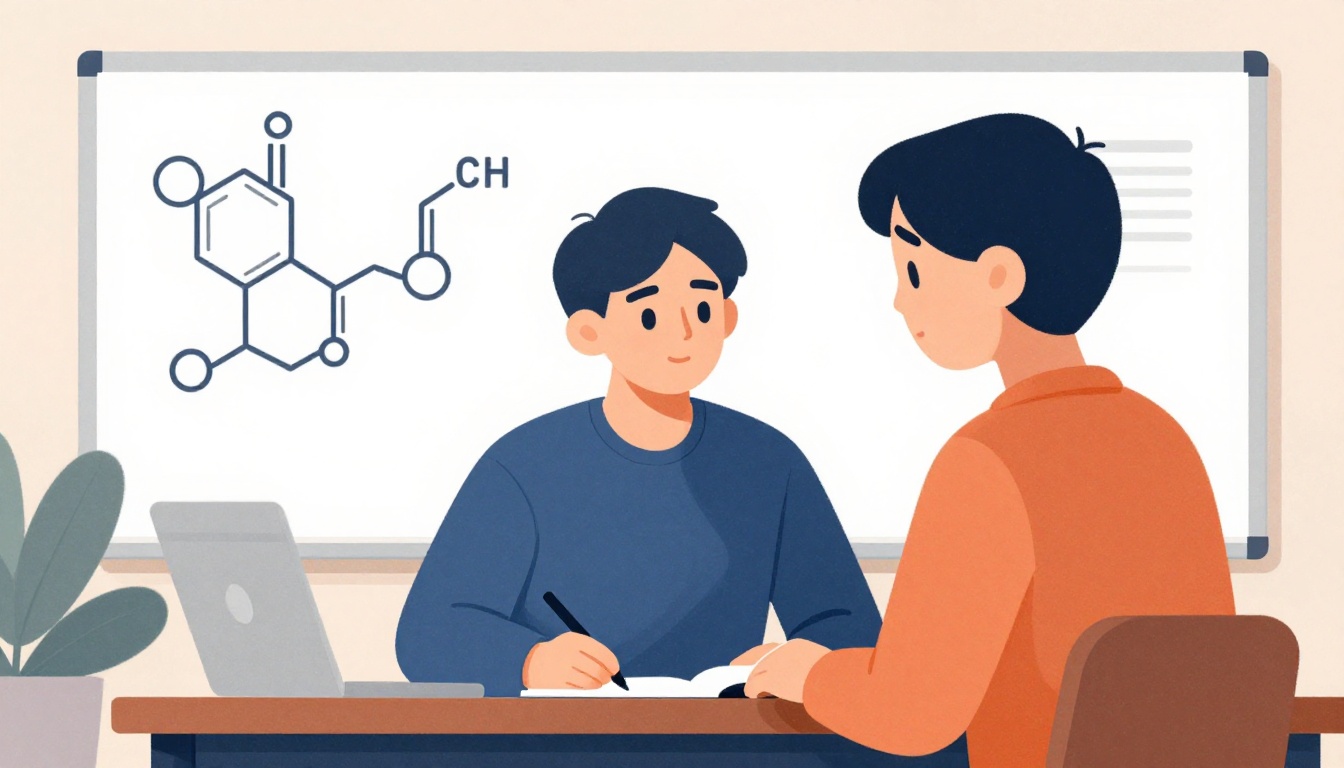
Organic chemistry often feels like a foreign language, and many students struggle despite hours of rereading notes. The key is not more passive review but active, targeted practice. A private tutor can guide you through this process, providing the structure and feedback that large lectures cannot. Here’s how to make the most of that one-on-one time.
Which of the following is a key strategy for mastering organic chemistry with a tutor?
Select one answer.
Why passive studying fails
Most students fall into the trap of rereading notes and memorizing reagents. According to Master Organic Chemistry, the real path to success is to "solidify your knowledge and find the gaps in understanding by doing problems." Simply recognizing a reaction when you see it is not the same as being able to predict the product on a blank page. A tutor can force you to actively recall and apply concepts, which is far more effective than passive review.
What a private tutor does differently
A good tutor does not just work through problems for you. As noted in a Reddit discussion on tutoring o-chem, effective tutors "always assume your students know nothing" and explain every step, rather than giving answers. This approach builds your own problem-solving skills. Your tutor should ask you to think aloud, predict the next step, and justify your reasoning. This is the opposite of watching a video or reading a solution manual.
Actionable steps to use with your tutor
To get the most out of each session, follow this checklist:
- Preview before the session. Spend 20–30 minutes reviewing the chapter or slides before your tutoring session. This gives you a baseline and helps you ask specific questions, as recommended by Savvy Premed.
- Drill functional groups and electronegativity. Memorize the names and structures of the ~16 common functional groups, and know the electronegativity order (F > O > N > Cl > Br > C > S > I > P > H). This is a "quick win" that pays off in every reaction, per Master Organic Chemistry.
- Fill in blank mechanism sheets. Your tutor can provide blank mechanism sheets for you to complete from memory. This is one of the best ways to learn mechanisms, according to UT Austin's organic chemistry guide.
- Practice working reactions backwards. Write a product and have your tutor help you deduce the starting materials and reagents. This builds synthesis skills and deepens your understanding of reaction maps.
- Use a whiteboard. Draw mechanisms large and often. As one Student Doctor Network user noted, seeing mechanisms in a larger context helps connect ideas.
- Ask questions immediately. Do not let confusion pile up. A tutor is there to answer your questions in real time, so bring your list of doubts to each session.
How to structure your tutoring sessions
Start each session by reviewing your notes and identifying gaps. Then, work through problems together, with the tutor asking you to explain each step. End by summarizing what you learned and what you will practice before the next session. This active cycle—preview, practice, feedback, review—mirrors the learning science that UT Austin recommends: "DO THINGS, do not just reread things when you study."
Quiz: Test your knowledge
Which of the following is a key strategy for mastering organic chemistry with a tutor?
- A) Rereading your notes multiple times
- B) Filling in blank mechanism sheets from memory
- C) Watching lecture recordings without pausing
Correct answer: B) Filling in blank mechanism sheets from memory. This active recall technique is recommended by experts as one of the best ways to learn mechanisms.
How the Featured Expert Can Help
If you're looking for personalized, one-on-one support in subjects like math, statistics, reading, or Python—which can complement your organic chemistry studies—consider Private Tutoring by Steve. Steve Washko offers in-person tutoring in Burleson, TX, and online sessions nationwide, covering kindergarten through college level. His approach focuses on individual learning plans and flexible scheduling, helping you build the skills and confidence you need to succeed.