
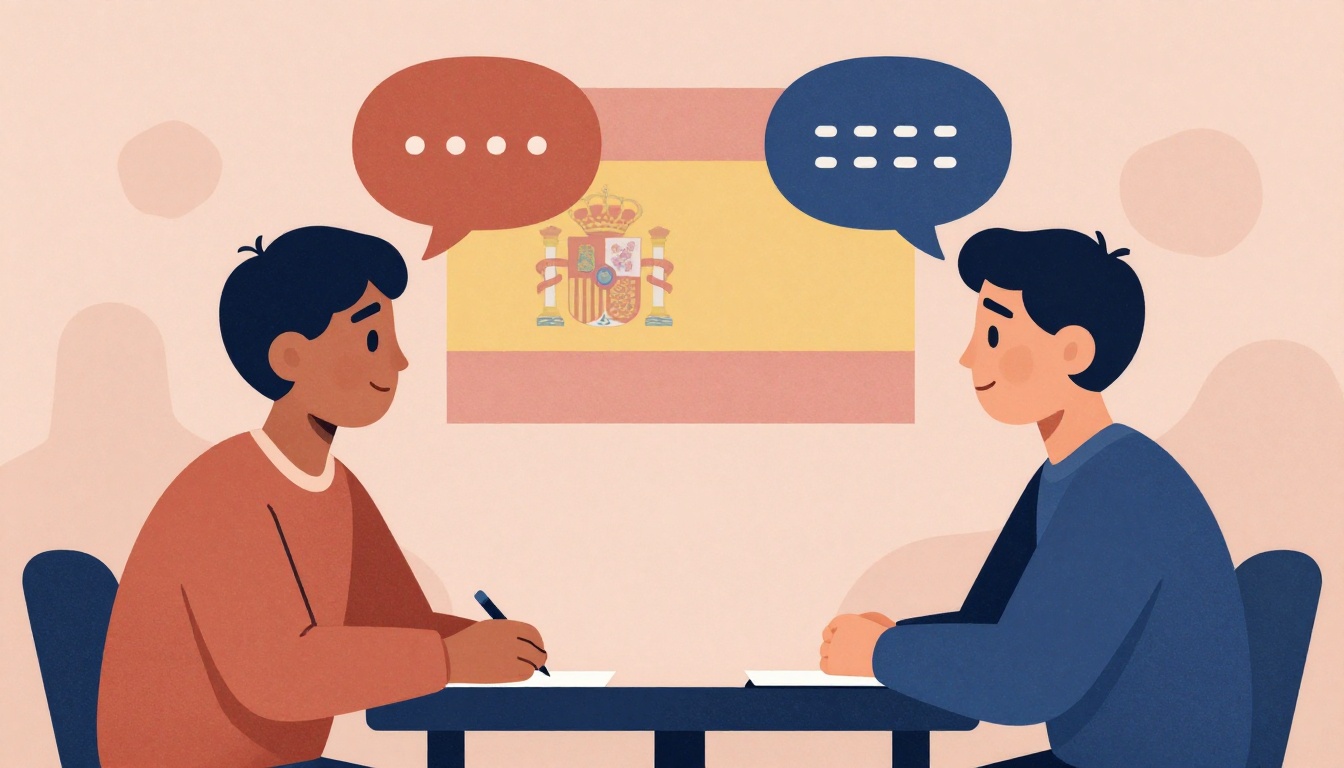
You've memorized vocabulary lists and drilled grammar rules, but when it's time to actually speak Spanish, the words don't come. This is the classic gap between knowing a language on paper and using it in real life. Private tutoring can bridge that gap, but only if you structure your sessions for conversation, not just more grammar drills.
Effective Spanish conversation practice combines specific phrases, realistic scenarios, and live correction—not random chatting. A skilled tutor provides the personalized guidance and structured speaking practice that self-study cannot replicate. Here's how to make the most of your private lessons.
Which of the following is a conversation repair phrase that helps keep a Spanish dialogue going when you get stuck?
Select one answer.
Build a foundation with conversation starters and chunks
Before you can hold a conversation, you need the right building blocks. Start by learning basic Spanish conversation starters and using "chunking"—memorizing common phrases as whole units rather than word-by-word. For example, instead of translating "How do you say...?" every time, learn the phrase ¿Cómo se dice...? as a single chunk. This reduces the cognitive load during real conversations.
Your tutor can help you identify the most useful chunks for your goals, whether you're preparing for travel, work, or social interactions. They can also provide Spanish dialogue examples to study and mimic, which builds familiarity with natural speech patterns.
Use repair phrases to keep conversations going
When your grammar breaks down mid-sentence, you need tools to keep the dialogue alive. Conversation repair phrases like ¿Cómo se dice...? (How do you say...?) and ¿Puedes repetir más despacio? (Can you repeat more slowly?) are essential. These phrases allow you to ask for help without losing the flow of the conversation.
Practice these repair phrases with your tutor until they become automatic. Your tutor can simulate situations where you get stuck and coach you on how to recover gracefully. This builds the confidence to handle unexpected moments in real conversations.
Practice with realistic role-play scenarios
Topic-specific vocabulary for restaurants, medical visits, airports, and workplace meetings gives you usable language faster than generic word lists. Role-playing these scenarios with your tutor provides live correction on pronunciation, word choice, and register—the level of formality appropriate for the situation.
For example, if you're planning a trip, practice checking into a hotel, ordering food, and asking for directions. Your tutor can play the other role and give you immediate feedback. This kind of high-engagement, low-stakes practice is one of the most effective conditions for language growth.
Structure your weekly practice routine
Consistency matters more than intensity. A recent study found that learners who included live Spanish lessons in their plan over two months learned faster and made more progress, especially in conversation skills. Aim for at least one or two tutoring sessions per week, and supplement with daily self-study.
A good weekly routine might look like this:
- Monday: 30 minutes of vocabulary review and listening to native Spanish audio.
- Wednesday: 60-minute tutoring session focused on a specific scenario (e.g., job interview, travel).
- Friday: 30 minutes of recording yourself speaking and comparing it to native models.
Recording yourself is a powerful self-assessment technique. It helps you identify areas for improvement in pronunciation, intonation, and grammar. Your tutor can also review your recordings and give targeted feedback.
Move from intermediate to advanced
Once you can handle basic conversations, push yourself to discuss more complex topics. Ask your tutor to introduce debates, cultural discussions, or current events. This forces you to use advanced vocabulary and complex sentence structures. It also exposes you to regional differences in Spanish, which is crucial if you plan to travel or work with speakers from different countries.
Your tutor can also help you fix common pronunciation habits that may be holding you back. For example, many English speakers struggle with the rolled 'r' or the distinction between 'b' and 'v' in Spanish. Targeted drills can make a big difference.
Quiz: Test your knowledge
Which of the following is a conversation repair phrase that helps keep a Spanish dialogue going when you get stuck?
- A) ¿Cómo se dice...?
- B) Me gusta el café.
- C) Hoy es lunes.
Correct answer: A) ¿Cómo se dice...? This phrase means "How do you say...?" and is a key repair strategy to keep conversations flowing.
How the Featured Expert Can Help
Steve Washko, owner of Private Tutoring by Steve, offers one-on-one tutoring in math, statistics, reading, and Python programming for students from kindergarten through college. While his primary focus is on STEM subjects, his personalized approach to tutoring—tailoring lessons to individual needs and providing flexible in-person or online sessions—can be adapted to support your broader learning goals. If you're in Burleson, TX, or prefer online sessions, reach out to discuss how his methods can help you achieve academic success.